Yes. In Western Australia, being back on light duties and having physio approved does not end your workers compensation entitlements. You may still be entitled to weekly payments, top-ups, and future lump-sum rights.
If you hurt your foot at work and you’re back on light duties, this is for you
Under WorkCover WA workers compensation claims and the Workers Compensation and Injury Management Act 2023 (WA), being “fit for suitable duties” does not mean your claim is over. You can still be entitled to weekly payments (income compensation), wage top-ups for overtime or allowances you’ve lost, and future permanent impairment rights. This often shows up as partial incapacity — you’re working, but you’re not back to your normal earning level or full pre-injury role. If your foot injury is starting to feel like nerve pain (burning, numbness, tingling), you need your entitlements checked early.
This is a very common workers compensation scenario for warehouse and distribution workers. A heavy item falls, your foot is injured, you’re put on light duties, and the insurer approves physio. Because you’re still working and getting paid, it feels like there’s nothing else to claim.
In reality, many workers with foot injuries and emerging nerve symptoms still have unfinished entitlements — especially 3–6 months after the accident, when symptoms evolve and earning capacity quietly changes.
Real WA example (anonymised): A Perth warehouse worker had a box fall onto their left foot. They returned on light duties within weeks and the workers compensation insurer paid physio. Months later, numbness and burning pain developed after long shifts. Overtime had stopped, but no one explained that partial weekly payments and future impairment rights could still apply.
This scenario is more common than you think. Check if you’re being underpaid on light duties using our free 2-minute assessment.
Can the insurer cut off my payments if my doctor says I am fit for work?
Yes. They can try. In WA, an employer / insurer can issue an Intention to Reduce Or Discontinue Income Compensation — Return To Work. Upon receipt of this notice, income compensation payments may come to an end, depending on how you deal with it. The notice must state the basis for the reduction or discontinuance with reference to the position to which the worker has returned and the amount, if any, of income compensation that will be paid to the worker for any partial incapacity for work.
If the insurer issues an Intention to Reduce Or Discontinue Income Compensation — Return To Work, can I challenge that notice?
Yes. A WorkCover WA arbitrator dealing with an application for determination of a dispute about a reduction or discontinuation of income compensation payments can determine whether the worker has returned to work, determine the amount of income compensation payment and make an order as to the making of those payments and the amount, if any, of those payments.
Got a ‘return to work’ notice? Book a confidential call today.
What does ‘return to work’ mean under workers compensation law
Section 5 of the Workers Compensation and Injury Management Act 2023 defines what “return to work” means for an injured worker who has some incapacity for work.
In simple terms, the law says a return to work is:
- First preference: the pre-injury job. If it’s reasonably practicable, the employer should provide the worker with the same position they held immediately before they became incapacitated, and the worker returns to that role.
- If that’s not possible: suitable alternative work. If the original position isn’t available, or the worker can’t safely do it anymore, return to work can mean the worker takes another position, either with the same employer or a different employer—so long as it’s a role:
- the worker is qualified for, and
- the worker is capable of performing.
In practice, this definition sets up a clear pathway: back to the same job where possible, and if not, into suitable work that matches the worker’s qualifications and current capacity. Understanding your WorkCover WA return-to-work rights is critical for protecting your earnings.
Can I still claim if I’m back at work on light duties in WA?
Short answer: Yes.
Under workers compensation law, still have workers’ compensation entitlements even if you’ve returned to work on light or modified duties. What matters is whether your injury reduces what you can safely do or earn overall — not whether you are still working or whether someone was at fault.
You may still have entitlements if:
- You’re on light or modified duties
- Your base hourly rate hasn’t changed
- The insurer is paying for physio or GP visits
- Your employer says it was “just an accident”
Key points many workers aren’t told:
- Light duties often mean you are not fully fit for your pre-injury role
- Treatment approval does not automatically cover wage loss or future impacts
- Workers’ compensation in WA is no-fault
- You can have an accepted claim and still be underpaid or under-supported
Light duties can hide real wage loss (even if your payslip looks the same)
In WA, a worker may be entitled to weekly workers’ compensation payments even while working, if their injury reduces overall earning capacity. This is known as partial incapacity.
This commonly happens when:
- Overtime drops out of your roster
- Weekend or late shifts stop
- Regular allowances disappear
- Your hours are capped due to pain or medical restrictions
- You cannot safely perform higher-paid or more physical tasks
In plain English: you are working, but not at your normal earning level.
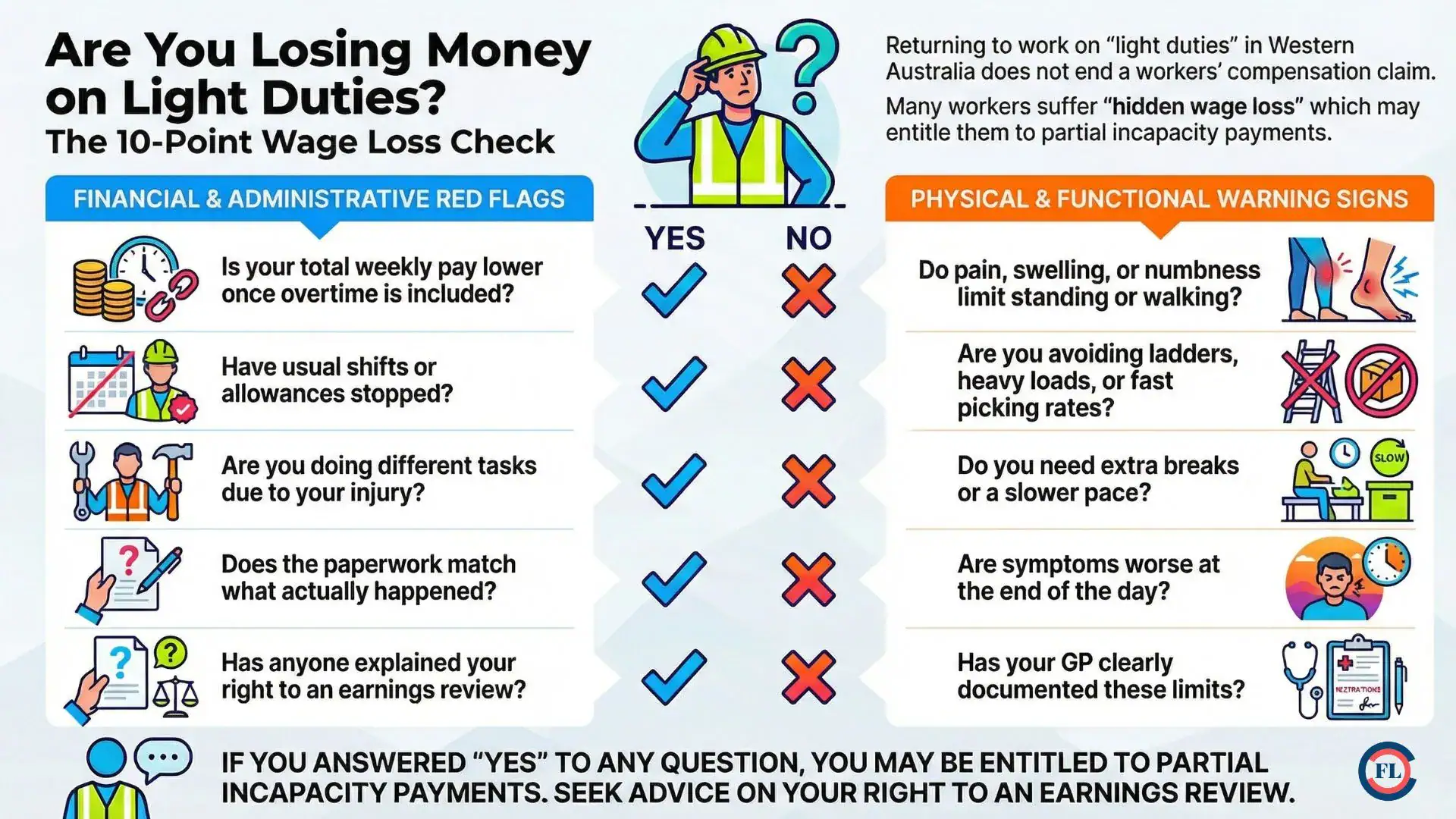
Light Duties Entitlements Check (WA)
- Is your total weekly pay lower once overtime is included?
- Have usual shifts or allowances stopped?
- Are you doing different tasks due to your injury?
- Do pain, swelling, or numbness limit standing or walking?
- Are you avoiding ladders, heavy loads, or fast picking rates?
- Do you need extra breaks or a slower pace?
- Are symptoms worse at the end of the day?
- Has your GP clearly documented these limits?
- Does the paperwork match what actually happened?
- Has anyone explained your right to an earnings review?
If you answered “yes” to several, your workers compensation entitlements may not fully reflect your situation. Contact Foyle Legal, or learn more about the injury claim process for WorkCover WA claims.
Foot injuries that turn into nerve symptoms months later
With crush-type foot injuries, nerve symptoms often appear gradually. This does not invalidate a workers compensation claim – CRPS and nerve injury claims often develop months after the initial incident. Clear, consistent medical documentation is what matters.
Common nerve-type symptoms include:
- Tingling or numbness
- Burning or shooting pain
- Sensitivity to pressure or footwear
- Swelling after shifts
- Balance or walking difficulties
What helps protect your claim:
- Keeping a simple symptom diary
- Reporting the same core symptoms to your GP
- Asking treating providers to describe functional limits, not just pain scores
- Updating work restrictions as symptoms change
This documentation supports treatment approvals, capacity decisions, and future impairment assessment.
For advice on claims where employer negligence may be a factor, please see our Personal Injury Law Guide
“It was just an accident” does not remove your Workers compensation rights
Workers’ compensation in WA is a no-fault system. An injury that occurs at or because of work can be compensable even if no one did anything wrong.
This means:
- You do not need to prove negligence for statutory workers compensation benefits
- Employer fault is not required
- Fault only becomes relevant in a separate common-law pathway, if it ever applies
Most warehouse and foot-injury claims never involve common law. The focus is on recovery, capacity, and fair entitlements.
See our guide to common workers compensation questions in WA for more detail.
Paperwork wrong? How to fix mismatches without causing problems at work
Minor errors in workers compensation paperwork are common and usually fixable. Addressing them early reduces stress and future disputes.
Common issues:
- Incorrect employer name
- Vague incident descriptions
- Missing witnesses
- Wrong dates or locations
Safe correction steps:
- Write one page: “What’s written” vs “What’s correct”
- Keep language factual and neutral
- Attach supporting documents if available
- Ask for written confirmation the correction is added
For more guidance, see our WA personal injury claims page.
Time limits and why waiting can be risky in WA
Decisions made while you are on light duties can affect future weekly payments and permanent impairment rights. There are strict time limits around impairment elections and dispute steps.
In WA, you generally have 21 days from receiving a reduction or discontinuation notice to lodge a dispute with WorkCover WA (s 64 WCIMA 2023). Extensions may apply in certain circumstances—contact us immediately to protect your rights.
Why this matters:
- Medical evidence gathered now affects impairment outcomes later
- Work capacity descriptions can shape long-term assessments
- Delays can limit options if symptoms worsen
Getting advice early is about protecting future choices, not escalating conflict.
What usually happens at 3–6 months in a Workers Compensation Claim
- Ongoing work capacity reviews
- Suitable duties planning
- Treatment approvals and reviews
- Earnings and weekly payment reassessments
If there is disagreement, WorkCover WA uses a structured dispute process called a WorkCover WA conference — not a court hearing. Most issues resolve here.
Why many WA workers speak to Foyle Legal
- WA-only workers’ compensation focus
- They have been issued with a Intention to Reduce Or Discontinue Income Compensation — Return To Work and don’t know what to do.
- Extensive experience with warehouse and manual-worker injuries
- We change our approach to suit what you want
- No upfront legal costs – our No Win No Fee solution means you only pay if we win your claim.
- Clear advice on light duties, earnings, and future protection
We regularly assist workers who were told everything was fine — until symptoms changed months later.
When a confidential consultation makes sense
A private check-in can help if:
- You are on light duties and overtime has dropped or you are not managing with your work duties.
- Foot pain or nerve symptoms are changing
- Paperwork does not feel right
- You want to understand impairment and future options
- You want to protect your job and your long-term health
👉 Book a confidential Workers Compensation consultation
Frequently asked questions about WorkCover WA light duties
Can I still get WorkCover WA payments if I am on light duties?
Yes. In Western Australia, being certified fit for light duties does not automatically stop your workers compensation payments.
If you’re partially incapacitated, you may still be entitled to weekly payments (income compensation). The amount is usually based on the difference between what you would have earned and what you earn (or are able to earn) on suitable duties.
If your light duties earnings are high enough, weekly payments can reduce to a smaller amount or even $0 for that period.
Do I lose workers compensation in WA if I go back to work on light duties?
No. Returning to work on light duties usually changes the calculation, not your right to claim.
If your pay drops because you’re working fewer hours or missing regular shift penalties or allowances that formed part of your normal earnings, you may still have a wage loss the insurer should take into account when calculating weekly payments.
What are my rights for a foot injury on light duties under WorkCover WA?
If your WorkCover claim is accepted, a work-related foot injury in WA may entitle you to:
- Weekly payments (income compensation) if you have a wage loss
- Reasonable medical and rehabilitation expenses
- Travel and other reasonable claim-related expenses
- In some cases, a permanent impairment lump sum if you’re left with permanent impairment (subject to assessment and eligibility)
Your entitlements depend on your certificate of capacity, your restrictions, how your suitable duties affect your earnings, and whether you have ongoing problems such as pain, altered gait, or reduced standing and walking tolerance.
Can nerve pain after a foot injury still be covered by WorkCover WA?
Yes. Nerve symptoms such as burning, tingling, numbness, shooting pain, or hypersensitivity can be covered under WorkCover WA if medical evidence supports that they are related to the work injury (or a consequence of it).
It helps to have these symptoms clearly recorded by your GP or specialist, including when they started and how they affect your function.
What should I do if my employer pressures me to go back to full duties?
Follow your medical restrictions. Your employer should not require you to work outside the restrictions on your WorkCover WA certificate of capacity.
Practical steps:
- Speak to your treating doctor and ask them to confirm your restrictions (and update the certificate if needed)
- Ask for the proposed duties in writing and compare them to your restrictions
- Keep records of what you were asked to do and when
- Get advice early if the pressure continues, especially if you’re worried the duties will worsen your injury
Your Next Steps: Light Duties Checklist

- Confirm what the workers compensation insurer is paying for.
- Compare total earnings to pre-injury pay, including overtime.
- Update GP certificates with clear restrictions.
- Record foot and nerve symptoms consistently.
- Fix paperwork errors early in writing.
- Review weekly payments if earnings dropped.
- Use a WorkCover WA conference if decisions don’t reflect medical reality.

Get Results for Your Injury Claim!
We Have Hundreds of Client Testimonials Just Like This One!
Get the Compensation You Deserve
Enquire Now, No Obligation

Claim your free initial legal advice worth $580!
Talk to a Real WA Lawyer Today
- No win no fee lawyers – nothing to pay upfront, no hidden costs, and disbursement assistance.
- Top-rated, WA law firm – recognised by clients and peers for our experience, with 300+ 5-star reviews on Google, Facebook and Trustpilot.
- Obligation-free assessment – maximise your fair compensation and we handle your claim end-to-end.
- We help clients to fight back against insurers every day – 100+ years of combined personal injury experience.
Offices in Perth CBD & Malaga. Serve all WA.
Talk to a Real WA Lawyer Today
- No win no fee lawyers – nothing to pay upfront, no hidden costs, and disbursement assistance.
- Top-rated, WA law firm – recognised by clients and peers for our experience, with 300+ 5-star reviews on Google, Facebook and Trustpilot.
- Obligation-free assessment – maximise your fair compensation and we handle your claim end-to-end.
- We help clients to fight back against insurers every day – 100+ years of combined personal injury experience.
Offices in Perth CBD & Malaga. Serve all WA.