In Western Australia, many survivors of childhood sexual abuse can still claim Criminal Injuries Compensation even decades later. In 2024/25, the OCIC paid $119.7 million across 9,171 awards and granted extensions of time on 1,026 applications. Psychological injury alone is compensable under section 9 of the Criminal Injuries Compensation Act 2003 (WA).
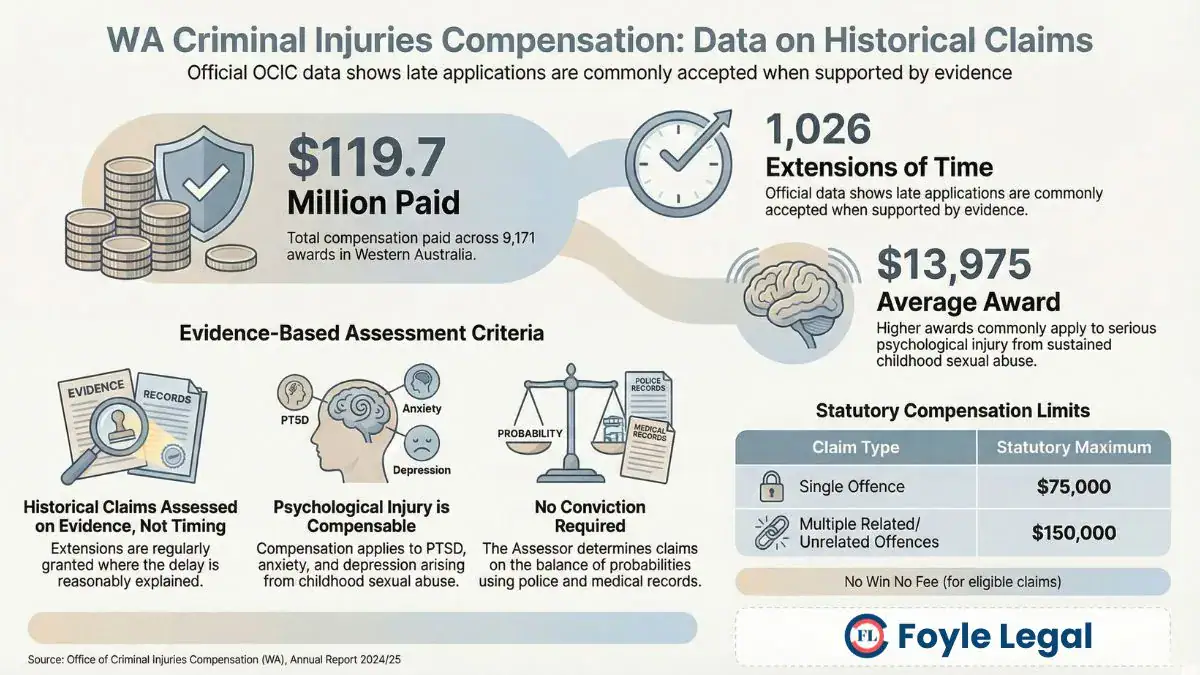
WA Criminal Injuries Compensation by the numbers (2024/25)
According to the Office of Criminal Injuries Compensation (OCIC) Annual Report 2024/25:
- $119.7 million was paid in Criminal Injuries Compensation across 9,171 awards in Western Australia
- 1,026 late applications were accepted through extensions of time
- The average award was $13,975, with higher awards commonly made for serious psychological injury arising from sustained childhood sexual abuse
These figures demonstrate that late applications are regularly accepted where supported by evidence and a reasonable explanation.
These figures demonstrate that late applications are regularly accepted where supported by evidence and a reasonable explanation.
Quick answer: you may still have a valid WA CIC claim
In WA, a compensation application must be made within 3 years after the offence to which it relates was committed or if it relates to more than one offence, the last of them
was committed.
Despite this, a Criminal Injuries Compensation Assessor, employed by the WA Government, may allow a compensation application to be made after the 3 years if he or she thinks it is just to do so and may do so. If the abuse happened a long time ago, or your main injury is psychological and it arises from a highly traumatic event, then it is likely that a Criminal Injuries Compensation Assessor will allow the claim to proceed out of time.
It is helpful to have exact dates but you do not need perfect dates, legal wording, or full paperwork before you start.
Key reassurance
- Psychological injury (PTSD, anxiety, depression) counts
- A conviction is not required to explore a claim, but you can not pursue a claim if the offender was acquitted (other than for unsoundness of mind).
- Missing records can often be obtained later
- You stay in control of what you share and when
➡️ Next step: Start with a quiet eligibility check or a confidential consultation.
Why Foyle Legal is trusted for WA CIC childhood abuse claims
Foyle Legal is a Western Australian personal injury law firm with long-standing experience acting in WA Criminal Injuries Compensation matters, including historical childhood sexual abuse claims.
What sets us apart:
- WA-based lawyers who regularly deal with the District Court of Western Australia and the Office of Criminal Injuries Compensation
- Deep experience preparing extension-of-time applications under section 9 of the Criminal Injuries Compensation Act 2003 (WA)
- Trauma-informed, document-focused approach to minimise re-telling and distress
- No Win No Fee for eligible CIC claims
- Experience assisting clients across Perth metro and regional WA, including the Pilbara, Kimberley, Goldfields, and South West
Unlike Legal Aid WA, you are able to choose your own lawyer for a Criminal Injuries Compensation claim, and receive dedicated, ongoing representation throughout the process.
For a full overview of how Criminal Injuries Compensation Claims in WA work, including types of crimes covered and general eligibility, visit our main CIC guide.
Eligibility in WA: historical childhood sexual abuse
You may be eligible for WA Criminal Injuries Compensation if:
- The abuse occurred in Western Australia
- You were a child at the time of the abuse
- The abuse has caused ongoing psychological injury
- The offending conduct has been reported to police (even many years later)
Important: reporting and cooperation with police
Under the Criminal Injuries Compensation Act 2003 (WA), the offending conduct must be reported to WA Police, and the claimant must reasonably assist authorities if requested by police or the Criminal Injuries Compensation Assessor.
A Criminal Injuries Compensation Assessor arguably could refuse a claim on the basis that a person who was the subject of child sexual abuse did not report the crime at an early time, however, in practice the Criminal Injuries Compensation Assessor usually does not raise non-compliance, so long as the crime has been reported by the time a claim is made. What matters most is cooperating once a report is made.
It is important to realise that a claim can be pursued even if there is no conviction and even if the offender cannot be identified or charged so long as the injured person can prove that they were injured as a result of a crime on the balance of probabilities.
Psychological injury is compensable in WA
Psychological injury alone is compensable under the Criminal Injuries Compensation Act 2003 (WA), including PTSD, anxiety, depression, and related conditions arising from childhood sexual abuse.
Common supporting evidence includes:
- GP, psychologist, or psychiatrist records
- Medication history
- Counselling attendance
- Evidence of work impact or reduced earning capacity
Learn more about PTSD & psychological injury claims in WA and how they are assessed.
The 3-year time limit in WA CIC – and why it often doesn’t end the claim
Section 9 of the Criminal Injuries Compensation Act 2003 (WA) sets a general 3-year time limit from the date of the offence (or the last offence), but expressly allows the Assessor to accept late applications where it is just to do so.
In historical childhood sexual abuse matters, extensions of time are commonly granted where the delay is reasonably explained.
Accepted explanations often include:
- Trauma-related inability to report earlier
- Delayed psychological impact
- Fear, shame, or lack of understanding of legal rights
- Criminal proceedings occurring many years later
While extensions are discretionary, clearly explaining why it took time is far more important than how long the delay was.
Do you need a conviction or guilty finding?
No. A person does not need to be charged, prosecuted, or convicted for you to pursue WA Criminal Injuries Compensation.
For CIC purposes:
- The Assessor considers whether the criminal conduct can be established on the balance of probabilities
- Police and court records are often used to confirm the offending conduct
- Survivors do not need to understand legal terminology such as “found guilty” or “convicted”
A lawyer can usually obtain:
- WA Police records
- Court outcome details (if any exist)
No paperwork? How WA CIC claims usually start
Not having paperwork is one of the most common reasons survivors delay seeking advice.
Many WA CIC claims begin with:
- A short written timeline (approximate months or years are acceptable)
- Names of treating doctors or counsellors
- Any known WA Police or court reference details
From there, records can often be obtained on your behalf. The process focuses on what is necessary, not exhaustive re-telling.
Read out the step-by-step guide: WA Criminal Injuries Compensation Claim Process.
What compensation can WA CIC include?
Depending on the circumstances, WA Criminal Injuries Compensation may include:
- Counselling and treatment expenses
- A recognition payment for the injury suffered
- Compensation for psychological injury
- Economic loss where trauma has affected work capacity
Statutory caps
- Maximum of $75,000 for a single offence
- Maximum of $150,000 for multiple related or unrelated offences by the same offender
In sustained childhood sexual abuse matters, awards may sit toward the upper end of the scale where long-term psychological injury and work impact are established. Outcomes depend on medical evidence and the individual facts, and remain subject to statutory limits.
For detailed examples and case studies, see our WA Criminal Injuries Compensation Payouts Guide.
What happens after you apply in WA?
Most WA Criminal Injuries Compensation matters are determined by the Assessor on documents rather than court appearances.
In most cases:
- You do not have to face the offender
- Information is handled confidentially by the Department of Justice
- Any hearings are procedural and lawyer-led
Your lawyer manages communication and limits unnecessary exposure to distress.
If your matter proceeds to a hearing, it will be determined by the District Court of Western Australia.
WA CIC steps (historical childhood sexual abuse)
- Call the WA Police Assistance Centre on 131 444 to report the offence or obtain an existing report reference
- Request your medical records via My Health Record or directly from your GP or psychologist
- Write a 1-page timeline using approximate months or years only (exact dates are not required)
- Prepare a short explanation for why reporting or claiming was delayed
- Lodge the WA Criminal Injuries Compensation application
- Respond to any Assessor requests for information (your lawyer manages this)
- Review the outcome and next steps
If you prefer to start quietly, a confidential conversation can help you decide whether to proceed.

Frequently Asked Questions – WA childhood sexual abuse CIC claims
Can I claim Criminal Injuries Compensation in WA if the abuse happened 20 or 30 years ago?
Yes. Under section 9 of the Criminal Injuries Compensation Act 2003 (WA), the Assessor can allow late applications where it is just to do so. Historical childhood sexual abuse claims are commonly accepted where delay is reasonably explained.
What if I never reported the abuse to police at the time?
You can still make a claim. Late reporting is common in childhood sexual abuse matters. The key requirement is that the offence is reported and you cooperate with police once a report is made.
Do I need a conviction to claim WA Criminal Injuries Compensation?
No. A conviction is not required. The Assessor decides claims on the balance of probabilities using police, court, and medical evidence.
Can I claim for psychological injury only?
Yes. Psychological injury such as PTSD, anxiety, or depression is compensable under the WA CIC scheme, even where there is no physical injury.
Next step: a confidential WA Criminal Injuries Compensation consultation
You do not need perfect dates, paperwork, or legal language to take the first step.
You can choose:
- A short eligibility check, or
- A confidential consultation focused only on what you’re comfortable discussing
Simple way to start:
“I experienced childhood sexual abuse in WA years ago. It has affected my mental health and work. I’m unsure about the time limit and records. Can you help?”

Get Results for Your Injury Claim!
We Have Hundreds of Client Testimonials Just Like This One!
Get the Compensation You Deserve
Enquire Now, No Obligation

Claim your free initial legal advice worth $580!
Talk to a Real WA Lawyer Today
- No win no fee lawyers – nothing to pay upfront, no hidden costs, and disbursement assistance.
- Top-rated, WA law firm – recognised by clients and peers for our experience, with 300+ 5-star reviews on Google, Facebook and Trustpilot.
- Obligation-free assessment – maximise your fair compensation and we handle your claim end-to-end.
- We help clients to fight back against insurers every day – 100+ years of combined personal injury experience.
Offices in Perth CBD & Malaga. Serve all WA.
Talk to a Real WA Lawyer Today
- No win no fee lawyers – nothing to pay upfront, no hidden costs, and disbursement assistance.
- Top-rated, WA law firm – recognised by clients and peers for our experience, with 300+ 5-star reviews on Google, Facebook and Trustpilot.
- Obligation-free assessment – maximise your fair compensation and we handle your claim end-to-end.
- We help clients to fight back against insurers every day – 100+ years of combined personal injury experience.
Offices in Perth CBD & Malaga. Serve all WA.