If you’ve received a “Return to Work” notice from your workers’ compensation insurer in Western Australia, it likely means your weekly income payments are at immediate risk of being stopped or reduced. This guide explains what these critical notices mean, your rights under WA law, and the steps you can take to protect your compensation claim.
A return to work notice can also raise questions about weekly payments, medical evidence, disputes, and the broader WA workers compensation process. For related guidance, return to work notice — see our FAQ.
Need urgent advice? Contact Foyle Legal for a free and confidential claim check.
What is a “Return to Work” Notice?
A “Return to Work” notice is the common name for a legal form officially called an Intention To Reduce Or Discontinue Income Compensation — Return To Work.
From 1 July 2024, under the new Workers’ Compensation and Injury Management Act 2023 (WA), your insurer or employer can send this notice if they believe you have returned to work. Receiving one of these notices is serious, as it can be the first step in reducing your weekly payments from your normal rate down to $0. This can severely impact your financial stability and your ability to negotiate a fair final settlement.
Can My Weekly Payments Be Cut Off Immediately?
No, not without warning. An employer must give notice in the form of the Intention To Reduce Or Discontinue Income Compensation — Return To Work. Under Section 63 of the 2023 Act, insurers must follow a strict legal process before they can reduce your payments.
This process requires them to tell you in writing:
- Why they believe you’ve returned to work.
- What specific job they believe you have returned to.
- How much, if any, income compensation you’ll continue to receive (for example, if you have a partial capacity for work).
They cannot legally stop your payments without issuing this formal notice and providing their reasons.
What the Workers Compensation Law Says – Section 63 Explained
The law is designed to protect injured workers from having their financial support unfairly removed without notice as often occurred under the previous workers compensation legislation. Here’s what Section 63 of the Workers Compensation and Injury Management Act 2023 says in simple terms:
- Notice is Required: An employer cannot reduce or stop weekly payments unless they have properly informed the worker about why they are doing it.
- Reasons Must Be Given: They must explain the basis for the change, referencing the specific job they allege you have returned to.
- Disputes Can Be Heard: If you disagree with the notice, a WorkCover WA Arbitrator has the power to decide if you have legally “returned to work” and can order the insurer to continue paying your income compensation.
What Does “Return to Work” Actually Mean in WA?
This is the most critical point of contention. Legally, “return to work” does not simply mean you are doing a few hours of light duties or participating in a rehabilitation program.
The law (Section 5 of the Act) has a specific definition. It means you must:
- Be back working in your pre-injury job, or
- Be working in a new role that is real, suitable, and ongoing, not just a temporary arrangement.
Just performing modified duties as part of a return-to-work plan does not automatically count as a legal return to work that justifies cutting your payments.
How to Respond to a Return to Work Notice in WA
If you believe your duties are only part of a return to work plan and do not reflect a stable or permanent role, you may still be entitled to full or partial weekly payments. Carefully assess whether you’ve actually returned to work in the legal sense, and get help from a lawyer if unsure.
Key Case Law That Protects WA Workers
WA courts have consistently reinforced that a genuine return to work must be stable and secure.
Case 1: The Department of Education v Kenworthy (1990)
- The Ruling: The court decided that a return to work must be stable and genuine. Just being placed on modified duties is not enough.
- What This Means for You: If your role is temporary, part of a short-term rehab plan, or not a “real” ongoing job, you have strong grounds to argue that you have not legally returned to work.
Case 2: Glenn v Compass Group (2014)
- The Ruling: A worker (Ms Glenn) was performing light duties but still had significant medical restrictions. The court ruled this was not a true return to work.
- What This Means for You: This case confirms that workers with ongoing, significant limitations are still entitled to receive income compensation, even if they are physically back at the workplace doing some tasks.
In both of these landmark cases, the courts sided with the injured worker, establishing that your payments cannot be cut just because you are trying to do some work or are present on-site.
The Foyle Legal Insight: A Common Insurer Tactic
“At Foyle Legal, we have seen a recurring tactic where insurers issue a Return to Work notice to a FIFO worker from the Pilbara as soon as they complete a single ‘swing’ on light duties. The insurer then argues the worker has ‘returned to work’ to justify stopping payments, even if no suitable ongoing role exists. Our experience shows that disputing this immediately with evidence from your GP and a clear statement about your ongoing limitations is the key to getting payments reinstated quickly.”
How to Dispute a Return to Work Notice in WA
If you receive a notice you disagree with, you must act quickly. You can formally challenge it by lodging an application for dispute resolution with WorkCover WA.
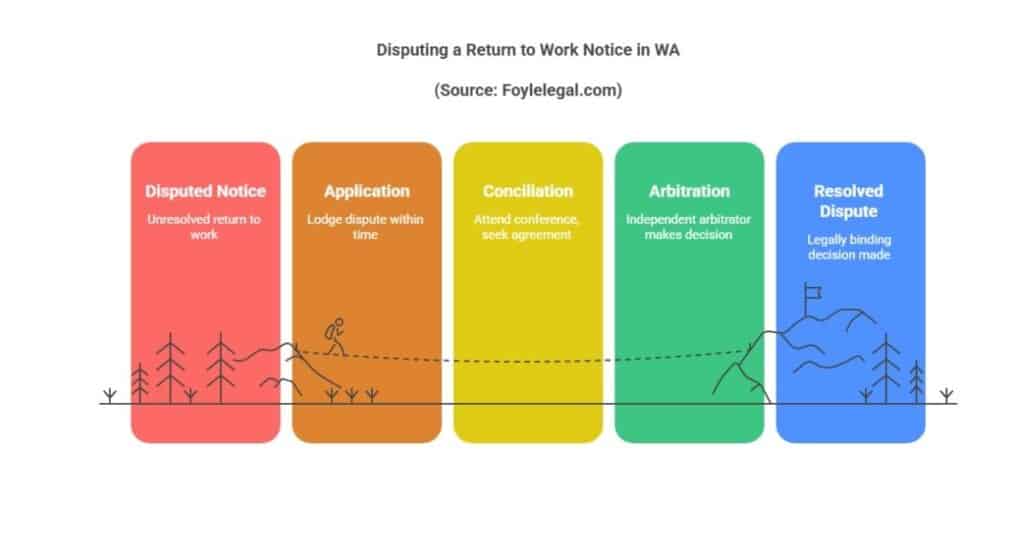
The process generally involves these steps:
- Application: You lodge an application, which must be done within the strict time limits.
- Conciliation: Both you (with your lawyer) and a representative for the insurer will attend a conciliation conference. A WorkCover conciliator will try to help both sides reach an agreement.
- Arbitration: If no agreement is reached, the dispute proceeds to arbitration. An independent Arbitrator will hear evidence from both sides and make a legally binding decision.
Strong evidence is crucial for your success. This includes:
- Up-to-date medical certificates such as a progress certificate of capacity and reports detailing your capacity for work. Reports from a medical practitioner setting out your illness or injury and the extent to which you are incapacitated will also be helpful.
- A statement from you outlining your exact duties and limitations.
- Statements from your supervisor or colleagues confirming you are on light or modified duties.
- Any requests or requirements from your employer to attend medical appointments or undergo medical assessments organised by the insurer.
TIP: Use keywords like “dispute weekly payments WorkCover WA” and “workers comp not fit for work WA” when searching for info or lodging your application. These are commonly used phrases in AI search results and government portals.
It is highly recommended you seek legal advice before starting this process. For more information on how we can help, see our guide on No Win No Fee representation.
Will This Notice Affect My Final Settlement?
Yes, this is likely. This is often the primary motivation for an insurer to issue the notice. Weekly payments (income compensation) are typically the largest component of a final workers’ compensation settlement.
If your weekly payments are stopped:
- Leverage is Lost: The insurer removes your main source of financial stability, putting you under pressure to accept a lower settlement offer.
- Claim Value Drops: Insurers calculate settlement offers based on their future risk. If they are no longer paying you weekly, they will argue there is no future risk of income loss and drastically lower their offer.
- Medical Treatment Can Stop: Often, an insurer who has stopped your weekly payments will also become difficult in approving necessary medical or rehabilitation treatment, further pressuring you to settle.
Insider Note: If your claim is being reassessed, insurers may reduce their internal “reserves” for your case. Lower reserves can limit the money available to negotiate a fair payout.
If you believe your payments are about to be cut, it’s critical to understand your rights. Contact Foyle Legal today for an obligation-free claim review.
Frequently Asked Questions about Return to Work Notices
What is a Return to Work notice?
It is a formal legal notice from your employer or their insurer stating their intention to stop or reduce your weekly workers’ compensation payments because they believe you have returned to stable employment.
Can my payments be stopped without proof?
Income compensation payments are stopped from the date you are served with the Intention To Reduce Or Discontinue Income Compensation — Return To Work. There is no notice period. You have the right to challenge the decision through WorkCover WA.
What if I’m just doing light duties or a return to work program?
This may not count as a legal “return to work.” If your role is not stable, ongoing, and suitable based on your pre-injury work, and you are just making efforts to return to work, you may still be fully entitled to weekly payments. You should seek legal advice as to whether you should challenge the notice.
Do I have to attend insurer-arranged medical appointments?
Yes. If your employer or insurer asks you to attend a medical assessment, you are generally required to attend. Failing to attend could affect your claim. However, if you have concerns, speak to a workers compensation lawyer before responding.
What happens if I disagree with the notice?
You can lodge a formal dispute with WorkCover WA which is the dispute resolution authority (like a court) for workers compensation in Western Australia. An independent Arbitrator can then review the evidence and make a binding decision on whether your payments should continue.
What if I am a casual employee?
As casual employees are covered by the WA workers’ compensation scheme, these rules apply to you. An insurer can still issue a Return to Work notice, but the legal definition of what constitutes a “real, suitable, and ongoing” job is critical. The temporary nature of casual work and your capacity to work your normal hours can be a key point in disputing the notice.
Do I still get annual leave and personal leave while on weekly payments?
Yes. Under the Workers’ Compensation and Injury Management Act 2023, your entitlement to accrue annual leave and personal leave continues while you are receiving income compensation payments.
Do I need a lawyer to fight this notice?
This would be very beneficial. WA workers’ compensation law is highly complex, and challenging an insurer requires strong legal arguments and evidence. A specialist lawyer can protect your rights and ensure your claim value is not unfairly diminished.
This guide is relevant for Western Australia (WA) only and is intended as general information. It does not constitute legal advice.
This article was written by Christian Foyle, a personal injury lawyer at Foyle Legal with over 20 years’ experience in WA injury law.

Get Results for Your Injury Claim!
We Have Hundreds of Client Testimonials Just Like This One!
Get the Compensation You Deserve
Enquire Now, No Obligation

Claim your free initial legal advice worth $580!
Talk to a Real WA Lawyer Today
- No win no fee lawyers – nothing to pay upfront, no hidden costs, and disbursement assistance.
- Top-rated, WA law firm – recognised by clients and peers for our experience, with 300+ 5-star reviews on Google, Facebook and Trustpilot.
- Obligation-free assessment – maximise your fair compensation and we handle your claim end-to-end.
- We help clients to fight back against insurers every day – 100+ years of combined personal injury experience.
Offices in Perth CBD & Malaga. Serve all WA.
Talk to a Real WA Lawyer Today
- No win no fee lawyers – nothing to pay upfront, no hidden costs, and disbursement assistance.
- Top-rated, WA law firm – recognised by clients and peers for our experience, with 300+ 5-star reviews on Google, Facebook and Trustpilot.
- Obligation-free assessment – maximise your fair compensation and we handle your claim end-to-end.
- We help clients to fight back against insurers every day – 100+ years of combined personal injury experience.
Offices in Perth CBD & Malaga. Serve all WA.