How much compensation for PTSD workers compensation psychological injury in Western Australia? $195,919.80 is awarded for a PTSD claim (post traumatic stress disorder claim) involving psychological injuries to a signal technician following a train derailment in Western Australia.
The defendant, a Big Mining Company with global dominance in iron ore mining, defended the claim, but the court ruled in favor of the plaintiff. This decision, cited as [2011] WADC 160, highlights employer negligence in a workplace accident.
Introduction: PTSD Workers Compensation Claim in WA
The case [2011] WADC 160, is a significant legal matter involving a workplace accident that led to a successful post-traumatic stress disorder (PTSD) claim. The plaintiff, suffered psychological injuries following a train derailment in his workplace. This case explores the complexities of psychiatric injury compensation, particularly for PTSD arising from employer negligence. It underscores critical aspects of personal injury law in Western Australia, including the duty of care for mental health in a hazardous work environment and the court’s application of foreseeability in psychiatric injury claims.
Claim Type: PTSD Workers Compensation and Common Law Negligence Claim
The claim was a common law negligence claim filed in the District Court of Western Australia. While The Plaintiff did submit a workers’ compensation claim form, this case primarily involved a negligence claim against the Big Mining Company for failing to provide a safe system of work, leading to his psychiatric injuries, including PTSD, anxiety, and depression.
Background
The Plaintiff was employed by Construction and Infrastructure Services Contractor as a signal technician and was working under a contract between Construction and Infrastructure Services Contractor and Big Mining Company.
The Plaintiff worked at the Construction and Infrastructure Services Contractor office in Perth in early January 2010, doing computer work, and also visited Construction and Infrastructure Services Contractor’s Port Hedland office. He was due back at the worksite on 17 March 2010 but did not return due to his ongoing symptoms of PTSD.
Despite attempting to ensure safety protocols were in place, the derailment led to severe psychological harm for The Plaintiff, including symptoms of PTSD such as anxiety, nightmares, and panic attacks. He claimed damages against Big Mining Company, alleging that Big Mining Company’s failure to provide a safe system of work was a breach of their duty of care, resulting in his traumatic stress and need for a PTSD compensation payout.
The Plaintiff sought a lump sum payout as compensation for his mental health condition and ongoing psychiatric injuries.
Injuries Suffered: PTSD and Psychological Injury
The plaintiff primarily suffered from Post-Traumatic Stress Disorder (PTSD), alongside symptoms of anxiety, depression, and panic disorder. These psychological injuries manifested after witnessing the derailment. Contrary to initial accounts, the court found that The Plaintiff was likely further away from the train than he claimed.
He was near his utility vehicle (Ute) at the time of the derailment and radioed for the train to stop. The claim that he was pinned or trapped by the door of the ute was found to be unreliable and possibly fabricated.
The Plaintiff also reported physical symptoms such as facial tenderness and chest tightness, but the court concluded that these injuries were likely fabricated to strengthen his claim and were not caused by the derailment. Additionally, the court found that his hernia and detached retina were unrelated to the derailment.
Role of Pre-Existing Psychiatric Conditions and Pre-Employment Health Assessment
A significant aspect of the case involved The Plaintiff ‘s pre-existing psychiatric conditions. Before joining the Construction and Infrastructure Services Contractor, The Plaintiff underwent a pre-employment health assessment on 10 March 2008, where he was required to disclose any previous psychiatric or psychological conditions.
During the assessment, he explicitly denied having any history of nervous disorders, including phobias, anxiety, or depression. However, evidence presented during the trial demonstrated that The Plaintiff had a history of severe psychological trauma stemming from his time in the South African military, during which he experienced combat situations, imprisonment, and a stabbing incident that left him seriously injured. This trauma led to symptoms indicative of PTSD and other psychological issues, for which he received treatment, including counseling and electroconvulsive therapy (ECT).
The omission of these details on the health assessment form became a point of contention, affecting The Plaintiff ‘s credibility. The court ultimately concluded that while The Plaintiff’s failure to disclose his psychiatric history on the form was misleading, it did not discredit his entire claim. The existence of his prior trauma also made him more susceptible to developing PTSD from the derailment incident, which the Big Mining Company had to take into account.
Circumstances of PTSD Injury and Employer Negligence
The incident occurred on 1 November 2009, while The Plaintiff was assisting with unlocking a derailer as part of a maintenance operation on the Big Mining Company’s Railway Line. After he unlocked the derailer, The Plaintiff asked the Big Mining Company’s Representative, if the route was set correctly, to which the Big Mining Company’s Representative responded affirmatively.
However, Big Mining Company’s Representative failed to ensure that the frog (a mechanism that controls the direction of the railway track) was properly set, which directly led to the derailment of a loaded iron ore train as it was reversing into a siding. The train, which consisted of several fully-loaded carriages, derailed violently, with carriages jack-knifing and spilling iron ore across the area.
The Big Mining Company admitted that Big Mining Company’s Representative, acting as their representative, did not properly secure the frog, which was a critical factor in preventing derailments. This negligence in ensuring all safety mechanisms were in place directly contributed to the accident and, consequently, to The Plaintiff’s psychiatric injuries. However, it should be noted that The Plaintiff’s role was limited to unlocking the derailer, and the primary responsibility for setting the frog lay with the Big Mining Company’s Representative.
Credibility Issues in PTSD Compensation Claim
Throughout the trial, The Plaintiff’s credibility was challenged due to inconsistencies in his statements about the injuries he suffered and his military background. He initially failed to mention certain physical injuries, such as being hit on the head by the utility door, until months after the derailment. Additionally, his recounting of the severity of the incident varied, leading to questions about his reliability as a witness. The court ultimately found that his claim of being pinned by the Ute door was fabricated, and there were significant doubts regarding his physical injury claims, such as the facial tenderness and chest tightness.
Moreover, The Plaintiff’s non-disclosure of a prior criminal conviction on his visa application further complicated his chances of obtaining permanent residency in Australia, affecting his future earning capacity claims.
The court also discussed the ambiguity surrounding the reasons for The Plaintiff’s termination. While there were disputes about whether the termination was due to his inability to work or other factors, the court found this lack of clarity to be relevant in assessing The Plaintiff’s credibility and future earning capacity claims. The court acknowledged that PTSD could affect memory and consistency in recounting traumatic events, but The Plaintiff’s credibility issues significantly impacted the assessment of his claim.
Medical Evidence Supporting PTSD Injury Compensation
- Dr. Peter McCarthy: Dr. McCarthy, a psychiatrist, played a pivotal role in diagnosing The Plaintiff with PTSD, major depressive disorder, and panic disorder with agoraphobia. Dr. McCarthy noted that The Plaintiff’s symptoms included severe anxiety, re-experiencing phenomena (such as flashbacks and nightmares), avoidance behaviors, and hypervigilance. He linked these symptoms to the derailment incident, noting that the derailment had triggered an acute exacerbation of The Plaintiff’s pre-existing PTSD, which had been relatively asymptomatic before the incident.
- Dr. Edwards-Smith: Dr. Edwards-Smith initially diagnosed The Plaintiff with an Adjustment Disorder with mixed anxiety and depressed mood. She observed that The Plaintiff had significant symptoms of anxiety and depression, which were impairing his daily functioning. Over time, as The Plaintiff’s condition failed to improve, she revised her diagnosis to PTSD, noting that the derailment incident was a significant contributing factor. She cleared The Plaintiff for a return to work with restrictions, but there were ongoing disputes regarding his fitness to work, especially given his visual impairment and its impact on his ability to perform his signal technician role. Dr. Silbert’s opposing opinion leaned towards The Plaintiff being unfit for work, which the court found more persuasive.
- Dr. Ang and Physical Injuries: The Plaintiff also sought medical attention from Dr. Ang, who noted persistent tenderness in the left side of The Plaintiff’s face, which The Plaintiff attributed to being struck by metal debris during the derailment. However, the court noted that The Plaintiff did not mention this injury immediately after the derailment, leading to questions about the accuracy of his claim regarding physical injuries.
- Progression of Symptoms: The Plaintiff was stood down after the derailment and did not return to Orefield Site until 25 November 2009. He worked until 10 November 2009 after the incident on 1 November 2009. Following the derailment, The Plaintiff ‘s symptoms gradually worsened. Initially, he continued to work, but by late November 2009, he reported symptoms such as nightmares, anxiety, muscle tightness, and uncontrollable shaking. These symptoms eventually led to his inability to continue working. Dr. McCarthy’s reports highlighted how The Plaintiff ‘s condition evolved from an initial acute stress response to chronic PTSD, requiring ongoing psychiatric care and treatment. The visa issue, while a significant stressor, was considered a complicating factor rather than the primary cause of his psychological condition, which was attributed mainly to the derailment.
Key Disputed Issues in PTSD Workers Compensation Claim
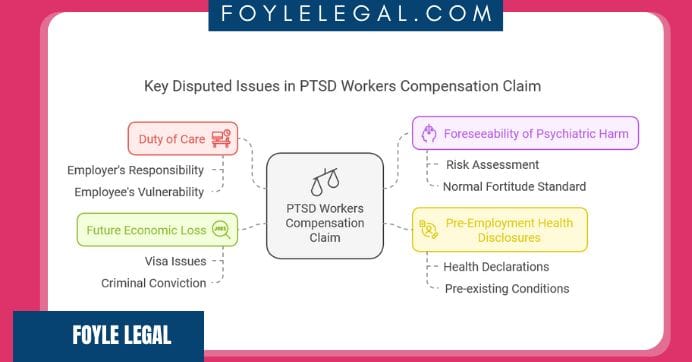
The main disputes revolved around:
- Duty of Care: Whether the Big Mining Company owed The Plaintiff a duty of care concerning his mental health, especially given his pre-existing vulnerability to PTSD.
- Foreseeability of Psychiatric Harm: Whether Big Mining Company could have reasonably foreseen the risk of psychiatric harm to a person of normal fortitude. The court assessed whether a person of normal fortitude, under the same circumstances, would have suffered psychiatric harm.
- Pre-Employment Health Disclosures: The accuracy of The Plaintiff’s health declarations during his pre-employment assessment, particularly regarding any pre-existing psychiatric conditions, which became a focal point during the trial.
- Future Economic Loss: The Plaintiff’s ability to obtain permanent residency and remain in Australia was a critical issue. His visa issues, including the non-disclosure of a prior criminal conviction, meant that he was likely to leave Australia, limiting his claim for future earnings.
Court’s Findings on PTSD Compensation Claim
The District Court of Western Australia determined that the Big Mining Company owed The Plaintiff a duty of care to ensure a safe working environment, including protection from foreseeable psychiatric harm. Under Section 5S of the Civil Liability Act 2002, the court concluded that the Big Mining Company should have foreseen the potential for psychiatric injury to a person of normal fortitude under such circumstances, especially given the inherently hazardous nature of railway work. Therefore, the Big Mining Company’s negligence in failing to ensure the frog was properly set was deemed to have directly caused the derailment and The Plaintiff ’s subsequent psychiatric injuries.
Compensation Payout for PTSD Claim
This case is an example of compensation payouts for PTSD claims in hazardous work environments.
The Plaintiff was awarded $195,919.80 in damages. The breakdown of compensation included:
- Past and future economic loss due to impaired earning capacity, but this was limited by the likelihood of The Plaintiff having to leave Australia due to visa issues.
- Special damages for medical expenses related to his psychiatric care.
- General damages for pain, suffering, and loss of enjoyment of life.
Legal Principles in PTSD Workers Compensation
The court applied several key legal principles in assessing liability and damages:
- Duty of Care and Foreseeability: the Big Mining Company was found to owe a duty of care to take reasonable steps to prevent psychiatric harm, as the derailment was a foreseeable risk in railway operations.
- Person of Normal Fortitude: Under the Civil Liability Act 2002, it was critical to determine if a person of normal fortitude would have suffered psychiatric harm under similar circumstances. The court concluded that this criterion was satisfied given the traumatic nature of the derailment.
- Egg-Shell Skull Rule: The court acknowledged that even if The Plaintiff was more vulnerable due to prior trauma, the Big Mining Company was still fully liable for the extent of his injuries, consistent with the “egg-shell skull” rule in personal injury law.
Implications of PTSD Compensation Claim in WA
This case has significant implications for personal injury law, particularly concerning employer negligence and PTSD claims. It emphasizes that employers must consider the mental health of employees, particularly in high-risk work environments. This ruling reinforces that foreseeable psychiatric injuries are just as compensable as physical injuries, promoting broader recognition of mental health risks in hazardous occupations.
The case also highlights the importance of thorough risk assessments and effective communication in ensuring workplace safety, particularly in industries like mining and railways where heavy machinery and hazardous conditions are prevalent.
A Quick Guide to PTSD Workers’ Compensation Claims in WA
This case study highlights several crucial aspects of PTSD claims; understanding these aspects can significantly impact a claim’s success. The following guide provides practical advice for navigating the claims process.
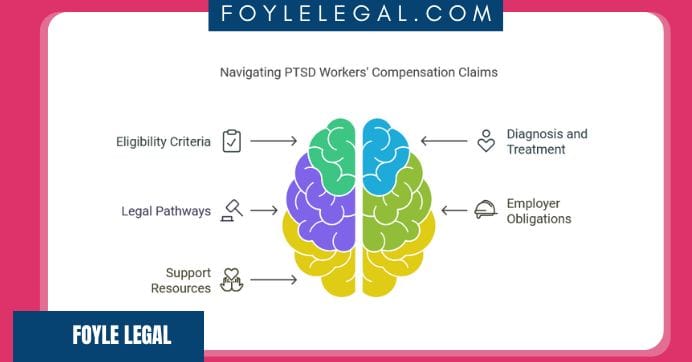
Eligibility for PTSD Compensation
If you suffer from PTSD due to a traumatic experience at work, like witnessing a train derailment (as seen in the case study), you may qualify for workers’ compensation. If you make a PTSD workers’ compensation claim and you have a whole person impairment of not less than 15% you could potentially choose to make a common law claim against your employer but you must prove that you have a whole person impairment of not less than 15% and your employer was negligent at trial.
If the PTSD occurred due to the negligence of another person or company then it is possible to bring a common law claim against that person or company. There is no requirement for a whole person impairment. In this kind of insurance claim, compensation payouts for PTSD australia can be higher, as there are no maximum caps, as there are in workers’ compensation payouts for PTSD.
Mental health disorder claims are frequnted rejected by insurance companies. Alawys work with exprienced personal injury lawyers to asses eligibility for compensation and guide you through the process before making a PTSD workers compensation claim in Western Australia.
Diagnosis and Treatment for PTSD
You need a clear PTSD diagnosis from a qualified mental health professional to start your PTSD compensation claim. In the case study, the plaintiff was diagnosed with PTSD after the train derailment. PTSD symptoms like nightmares, anxiety, and panic attacks were part of the basis for his PTSD injury claim. Seek treatment early to strengthen your claim and ensure the best possible care. Usually a report will be needed from a psychiatrist.
PTSD as a Disability and Financial Compensation
Severe PTSD may qualify as a total and permanent disability (TPD). You could be entitled to claim lump sum compensation if your PTSD prevents you from working through a TPD claim.
TPD Compensation payouts for PTSD in Australia are usually a lump sum payment and are different to workers comp PTSD claims which can include benefits for economic loss and medical costs. If you suffer from posttraumatic stress disorder and are struggling to work, consider making a PTSD compensation claim.
Working with PTSD
PTSD is a psychological condition and usually arises from witnessing a traumatic event.
Workers with PTSD have rights to workplace accommodations which in the context of workers compensation claims for PTSD is usually accomedated through a return to work program.
In the case study, disputes revolved around the worker’s ability to continue employment due to PTSD. It’s important to discuss accommodations with your employer and claim compensation if working conditions worsen PTSD symptoms. Employers must provide a safe working environment, if you want to know more about possible compensation benefits find out more about how to claim PTSD compensation.
How to Make a PTSD Compensation Claim
To make a PTSD compensation claim for workers compensation you will need to complete a workers compensation claim form and a first medical certificate and then provide both documents to your employer.
It is often the case that claims are not accepted or the workers compensation insurer will try to minimise or deny your claim. Injured workers will need to gather all medical reports, witness statements, and employer safety records In case a common law claim is pursued).
The derailment case highlighted the importance of proving negligence in claims for PTSD. Use experienced workers compensation & personal injury lawyers to minimise or deny any issues in your claim. A win no fee lawyer can assist you, meaning you don’t pay unless you win your claim.
Legal Representation and No Win No Fee Claims
Hiring an experienced personal injury lawyer is highly recommended when dealing with psychological injury claims. The plaintiff in the case study faced challenges because of inconsistent statements. Find a win no fee lawyer who is speicalised in PTSD claim to avoid upfront legal costs and ensure you get PTSD compensation payout for psychiatric disorders caused by traumatic stress.
Compensation for PTSD in Different Scenarios
The value of your PTSD compensation depends on the situation. In the train derailment case, compensation included economic loss and psychiatric care. Payouts for PTSD are calculated by reference to the medical evidence in a case. PTSD claims for exposure to a traumatic event, like PTSD due to workplace accidents, can lead to substantial compensation payouts for PTSD Australia-wide. An experienced lawyer will help determine the value of your compensation.
Support for People with PTSD
If you or someone you know has PTSD from a workplace incident, seek help from mental health professionals. People with PTSD should also explore community resources. PTSD can be a challenging disorder following a traumatic experience, but support is available. A free claim check can also help determine if you are eligible to claim PTSD compensation.
Preventing PTSD and Employer Obligations
Employers have a duty of care to prevent PTSD and other psychological injuries. Safe Work Australia guidelines require employers to create safe systems of work. In the case study, negligence in securing a railway mechanism led to the derailment and PTSD injury. Employers must take reasonable steps to prevent traumatic experiences at work that can cause PTSD, or they may be liable for personal injury compensation.
Take Action Now
If you are diagnosed with PTSD from a workplace accident, take action quickly. Contact a lawyer experienced in PTSD workers’ compensation claims to understand your rights. The sooner you begin, the better your chances of a successful PTSD compensation payout. An obligation free claim consultation can help you get started.
Conclusion: Lessons from PTSD Compensation Claims
The Case of [2011] WADC 160 underlines the evolving recognition of psychological injuries in personal injury law. The court’s acknowledgment of The Plaintiff ’s psychiatric injuries and the subsequent award of compensation illustrate the duty of care that employers must uphold for both the physical and mental well-being of their employees. The case serves as an important precedent for handling common law negligence claims involving psychiatric injury, emphasizing that mental health deserves equivalent protection under the law as physical safety. Employees facing similar situations should seek prompt legal advice to understand their rights and pursue compensation effectively.

Get Results for Your Injury Claim!
We Have Hundreds of Client Testimonials Just Like This One!
Get the Compensation You Deserve
Enquire Now, No Obligation

Claim your free initial legal advice worth $580!
Talk to a Real WA Lawyer Today
- No win no fee lawyers – nothing to pay upfront, no hidden costs, and disbursement assistance.
- Top-rated, WA law firm – recognised by clients and peers for our experience, with 300+ 5-star reviews on Google, Facebook and Trustpilot.
- Obligation-free assessment – maximise your fair compensation and we handle your claim end-to-end.
- We help clients to fight back against insurers every day – 100+ years of combined personal injury experience.
Offices in Perth CBD & Malaga. Serve all WA.
Talk to a Real WA Lawyer Today
- No win no fee lawyers – nothing to pay upfront, no hidden costs, and disbursement assistance.
- Top-rated, WA law firm – recognised by clients and peers for our experience, with 300+ 5-star reviews on Google, Facebook and Trustpilot.
- Obligation-free assessment – maximise your fair compensation and we handle your claim end-to-end.
- We help clients to fight back against insurers every day – 100+ years of combined personal injury experience.
Offices in Perth CBD & Malaga. Serve all WA.