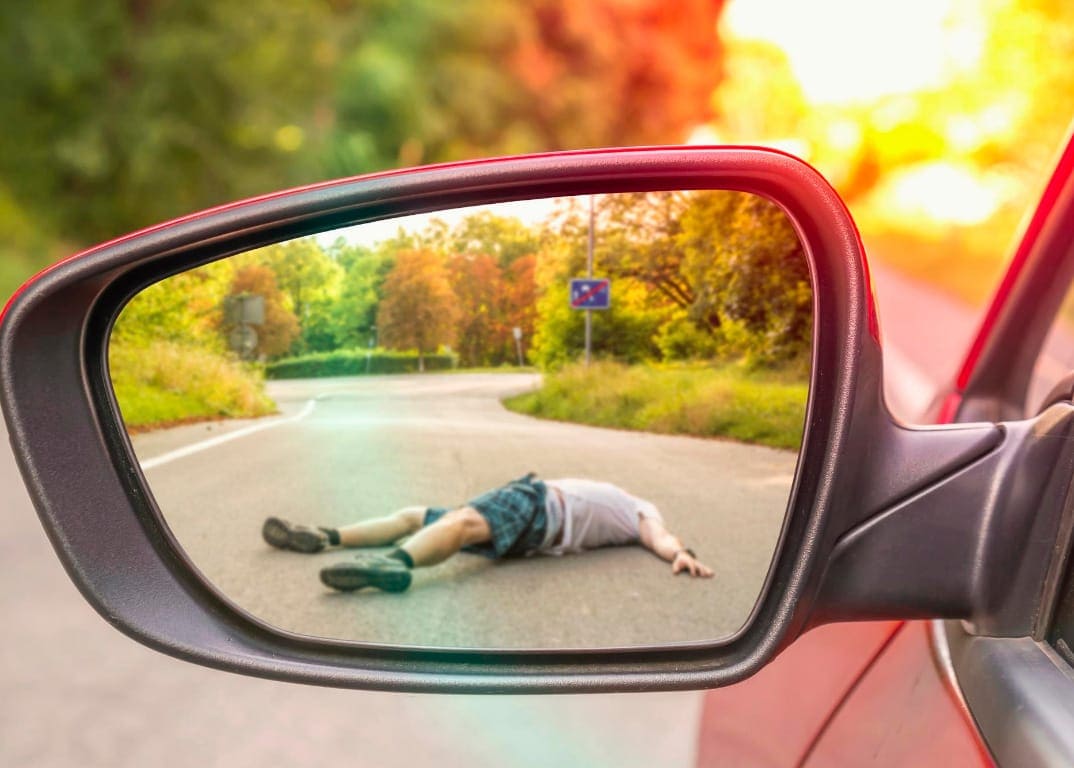
Western Australia’s latest official road trauma data paints a sobering picture. In 2024, 1,600 people were killed or seriously injured (KSI) on WA roads — 188 deaths and 1,412 serious injuries from 1,381 crashes. That is an 8% reduction on the previous five-year average, but it still means that, on average, more than four people are killed or seriously injured on WA roads every day.
This guide answers the most common questions we get asked about WA road accidents, using the current data — and explains what to do if you or a loved one is involved in one. All statistics are from the Road Safety Commission’s Western Australian Road Fatalities and Serious Injuries 2024 report (published June 2025) unless stated otherwise.
- How do road accidents happen?
- What should I do after a car accident?
- What is a common cause of fatal crashes?
- Who is most at risk on WA roads?
- Where do most fatal crashes happen?
- What speed do fatal crashes happen at?
- When do crashes happen?
- How often is someone killed on Western Australian roads?
- How has WA road safety changed since 2015?
How do road accidents happen?
Road accidents happen on WA roads every day. Some of the ways in which car accidents happen include:
- Rear-end collisions – These accidents occur when one vehicle collides with another vehicle from behind. This is probably the most common car accident claim in Western Australia. Usually, the driver of the vehicle that hits another vehicle from behind will be at fault but it depends on the circumstances of how the accident occurred.
- Head-on collisions – Head-on collisions are more likely to occur in regional WA. This car crashes often result in serious injury claims or road death-related dependency claims. It is important to drive within the speed limit in regional areas and take regular breaks to avoid fatigue. There is often a dispute regarding liability in these claims as both drivers claim that the other vehicle veered into their side of the road.
- One vehicle collisions – These collisions usually include scenarios where the driver loses control of their vehicle and the vehicle leaves the road. These claims are more common in regional WA. An example may be when a driver loses control on main roads in the South West of WA, leaves the road and hits a tree. Usually, only the passenger(s) will be able to make a claim in this kind of motor vehicle accident.
- Pedestrian Accidents – These accidents occur when a car collides with a pedestrian. Depending on the speed of the car and the position of the pedestrian, pedestrians can suffer from serious injury. Similar to the car hitting cyclist claims, liability is often in dispute in these accidents. The pedestrian will have to prove that the driver was negligent. The driver will often say that they were not negligent in causing the incident and that the pedestrian entered the roadway suddenly and without warning. It is important to report these injuries to WA Police so that they can investigate the circumstances of the accident.
What should I do after a car accident?
Following a car accident, you should make sure you have moved your car to a position of safety if it is still drivable. Saving lives should always be the priority and it may be necessary to call an ambulance to take one or more people to the hospital.
If you are able to do so, you should take photographs of the accident scene and take down witness details. You should also exchange details with the person who is driving the other vehicle involved (if there is another vehicle). If you are in a region of WA that you do not know well, it may be worth looking up a map location before calling WA police to report the injury. If the Police do not attend you should still report the crash through crashreport.com.au.
If you have been injured as a result of the accident you should seek immediate medical attention to ensure that your injuries are documented. It is important to understand who is at fault in a car accident. If you consider that you were not at fault, or were only partially at fault a CTP injury claim may be made with the Insurance Commission of Western Australia, the compulsory third-party insurer in Western Australia.
What is a common cause of fatal crashes?
According to the 2024 data, the behaviours most often involved in fatal crashes in WA are:
- Speed — a factor in 34% of fatalities (but only 12% of serious injuries, showing how strongly speed correlates with the worst outcomes);
- Fatigue — a factor in 24.5% of fatalities;
- Not wearing a seatbelt — 16% of motor vehicle occupants killed were not wearing one;
- Inattention — a factor in 11.2% of fatalities.
The 2024 report does not publish alcohol and drug involvement figures because of changes in data-sharing arrangements; in earlier years, alcohol was typically involved in around a quarter of WA road deaths.
Who is most at risk on WA roads?
Males accounted for 79% of road deaths in 2024 (149 of 188) and 60% of serious injuries. People aged 20–29 made up 19% of everyone killed or seriously injured — the largest share of any age group — while males aged 17–19 had the highest KSI rate per 100,000 people.
Motorcyclists are heavily over-represented: they made up 18% of all people killed or seriously injured (286 people, including 40 deaths), far beyond their share of traffic. Pedestrians accounted for 153 KSI (22 deaths) and cyclists 74 KSI (4 deaths), while light vehicle occupants — drivers and passengers of cars, utes and vans — made up the majority at 1,042 KSI (112 deaths).
Where do most fatal crashes happen?
Regional WA carries the heaviest share of the road toll: 61% of all 2024 fatalities (114 deaths) occurred in regional areas, and 68% of regional fatalities happened in speed zones of 100 km/h or more. Serious injuries show the opposite pattern — 71% occurred in the metropolitan area, where traffic is densest.
Compared with the five-year average, fatalities fell sharply in the Kimberley (down 58%), Goldfields-Esperance (down 34%) and Midwest-Gascoyne (down 33%), but the Wheatbelt recorded the largest increase, up 60%.
What speed do fatal crashes happen at?
Speed zones tell the story of WA’s two different road trauma problems. In 2024, 64% of fatalities occurred on roads with speed limits of 80 km/h or more — the high-speed highways and country roads where crashes are most likely to be deadly. Serious injuries concentrate at the other end: 64% occurred on roads with limits of 70 km/h or less, the busy metropolitan streets where crashes are frequent but more survivable.
When do crashes happen?
More than a third of all KSI (39%) occurred between noon and 6pm, with 3pm–6pm the deadliest window (16% of fatalities). Friday recorded the most people killed or seriously injured of any day (16%), while Saturday recorded the highest share of deaths (19%).
How often is someone killed on Western Australian roads?
In 2024, 188 people died on WA roads — on average, a death roughly every second day. Counting serious injuries as well, more than four people were killed or seriously injured on WA roads every single day of 2024.
How has WA road safety changed since 2015?
A decade ago, the Road Safety Commission’s 2015 crash report recorded 161 road deaths in WA. In 2024 the figure was 188 — 17% higher, despite a decade of vehicle safety improvements and the WA Government’s Driving Change – Road Safety Strategy 2020–2030. Some patterns have barely moved: regional WA accounted for 57% of deaths in 2015 and 61% in 2024, and high-speed zones remain the deadliest in both datasets (the largest share of 2015 deaths occurred in 110 km/h zones; in 2024, 64% of deaths were on roads of 80 km/h or more). Speed’s involvement in fatal crashes is almost unchanged — 36% then, 34% now.
One note on the data: the 2015 report counted all 32,392 reported crashes, while today’s reports track people killed or seriously injured, so only deaths and their patterns can be compared directly.
Sources:
- Road Safety Commission (WA), Western Australian Road Fatalities and Serious Injuries 2024 (June 2025)
- Road Safety Commission (WA), Reported Road Crashes in Western Australia 2015
- WA Government, Driving Change – Road Safety Strategy 2020–2030
If you are injured in a car accident and made a personal injury claim in WA, contact Foyle Legal for your obligation-free initial claim review. We have a team of car accident lawyers in Perth who can provide legal representation on a NO WIN NO FEE basis.

Get Results for Your Injury Claim!
We Have Hundreds of Client Testimonials Just Like This One!
Get the Compensation You Deserve
Enquire Now, No Obligation

Claim your free initial legal advice worth $580!
Talk to a Real WA Lawyer Today
- No win no fee lawyers – nothing to pay upfront, no hidden costs, and disbursement assistance.
- Top-rated, WA law firm – recognised by clients and peers for our experience, with 300+ 5-star reviews on Google, Facebook and Trustpilot.
- Obligation-free assessment – maximise your fair compensation and we handle your claim end-to-end.
- We help clients to fight back against insurers every day – 100+ years of combined personal injury experience.
Offices in Perth CBD & Malaga. Serve all WA.
Talk to a Real WA Lawyer Today
- No win no fee lawyers – nothing to pay upfront, no hidden costs, and disbursement assistance.
- Top-rated, WA law firm – recognised by clients and peers for our experience, with 300+ 5-star reviews on Google, Facebook and Trustpilot.
- Obligation-free assessment – maximise your fair compensation and we handle your claim end-to-end.
- We help clients to fight back against insurers every day – 100+ years of combined personal injury experience.
Offices in Perth CBD & Malaga. Serve all WA.